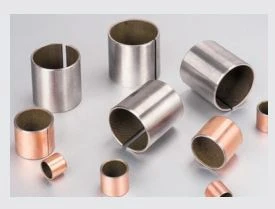
The common damage phenomena of bushing are alloy layer wear, scratches, dissolution, and peeling, but sometimes there are also some abnormal damage phenomena.
1. Uneven wear of bushing
(1) Excessive wear near the mating surface of the bushing. There are two main reasons: 1. The free opening elasticity of the bearing is insufficient. 2. The selected bearing shell is not suitable and the interference is too large, causing excessive deformation after pressing it into the bearing shell and tightening the bearing cover. Therefore, during maintenance, attention should be paid to checking the free opening elasticity and the height of the bearing pad protruding from the bearing seat. If the free opening elasticity tensor is too small, a new tile should be selected; If the bearing shell is too high, a small amount of file repair can be done on the end of the bearing shell without the positioning key.
The edges on both sides of the bearing are worn off. It often appears on the bearing surface that matches the newly polished crankshaft journal, due to improper grinding causing the journal busbar to be concave. To prevent this situation, when inspecting the worn journal, in addition to measuring its diameter at both ends according to normal requirements, the middle data of the journal should also be measured. When it does not meet technical requirements, the crankshaft journal should be re ground instead of simply cutting the bushing.
2. Corrosion of bushing
Corrosion of bushing mainly occurs on copper lead alloy bushing without coatings, and the working surface of the entire bearing shell presents needle hole like pitting or pitting, with the bearing surface turning black. The main reason is severe deterioration or misuse of lubricating oil.
3. Wear marks and rust spots on the back of the bearing liner
Sometimes a large dark area may appear on the back of the bearing pad, with obvious friction marks along the circumference. In severe cases, the bearing pad seat hole may appear elliptical due to wear. The main cause of this fault is insufficient interference between the bearing shell and the seat hole or wear of the positioning key. At this time, under the action of cyclic loads, there is repeated circumferential slight misalignment friction between the bearing liner and the bearing seat hole, causing the bearing liner to heat up and subsequently oxidize and rust. Therefore, during assembly, the interference fit of the bearing shell (i.e. the height of the bearing shell protruding from the bearing seat plane) and the positioning key of the bearing shell should be checked for completeness, and attention should be paid to the uniform and standard tightening torque of the bearing cover bolts. When the bearing seat hole becomes out of round due to wear or the hole neck becomes larger, tin or zinc can be plated on the surface of the seat hole.
4. Cracking
Cracking refers to the appearance of fine cracks on the surface of the bearing alloy, and the cracks are crisscrossed in a network like pattern with no regularity or fixed direction. Cracking is a fatigue damage phenomenon of bushing. If left untreated, oil can seep into the cracks during operation, creating a wedging effect and easily causing the alloy layer to fall off in pieces.
The reason for cracking: 1. The temperature of the bearing shell is too high. 2. Overloading or out of roundness of the bearing shell is accompanied by strong impact force during operation. 3. The eccentric wear of the bearing pads results in uneven load distribution.
During the repair process, any bushing that can still ensure the thickness of the alloy layer and bearing clearance after sanding or scraping off the crack layer can be reinstalled and continue to be used after troubleshooting. Otherwise, new parts should be used after troubleshooting.
5. Embracing tiles
After the occurrence of tile sticking, corresponding measures should be taken according to the degree of tile sticking. If the bearing shell forms several shallow annular grooves near the crankshaft passage hole, it can be scraped and continued to be used for a period of time; If the alloy layer of the bearing is mostly transferred or completely detached, it cannot be used anymore.
The contact area between the scraped bearing alloy layer and the crankshaft journal should be at least 75%. When inspecting the contact area between the bearing and the journal, the method of applying red lead oil is commonly used. But if it is an aluminum alloy bearing, due to its low hardness, it can still show contact marks without applying red lead oil. The alloy layer of aluminum alloy bearings is generally gray, and if a bright part is exposed on the bearing, it is a contact mark.
2024 April 2nd Week Marginal Product Recommendation:
MG-TEX Steel with PTFE Fiber Fabric Bearings:
This new material uses the PTFE fibre fabric overlay on steel backing, the fabric is with high load capacity and much longer operating life comparing with conventional 3-layer bushes.The metal matrix provides the bearing with excellent load-bearing performance and can transfer the heat generated during the operation of the bearing in time, while PTFE woven material is designed to be used in completely dry friction conditions. It has a lower friction coefficient and excellent wear resistance. Compared with traditional bearings, in addition to high load performance, it can completely eliminate oil and eliminate process maintenance, and it slides smoothly. There will be no "sticky" phenomenon.