

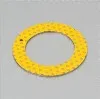
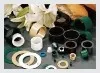
Plastic Sliding Bearings
Marginal Plastic plain bearings provide excellent wear resistance and low friction in both dry and lubricated operating conditions over a wide range of applications.Engineered plastic bearings are made from thermoplastic bearing material processed by injection moulding.It uses high-performance plastics as the raw material, and filled high-strength fibers and special solid lubricants.
Why Choose Us
Professional Team
We have a team of experienced professionals dedicated to ensuring that every aspect of our business follows the highest standards.
Rich Experience
Dedicated to strict quality control and attentive customer service, our experienced staff is always available to discuss your requirements and ensure complete customer satisfaction.
High Quality
Our products are manufactured or executed to very high standards, using the finest materials and manufacturing processes.
Our Service
Our professional team is composed of pre-sales, sales, and after-sales experts who are dedicated to providing excellent service throughout the entire customer service process.
What is Plastic Sliding Bearings
Plastic sliding bearings are a type of bearing that utilizes plastic materials as the sliding surface. They are designed to support rotational or linear motion between two components, minimizing friction and wear. The choice of plastic for these bearings is based on its unique properties such as low friction coefficient, good wear resistance, corrosion resistance, and the ability to operate without lubrication under certain conditions.
-
![Margianl LCB Plastic Clip Linear Bushings]() Margianl LCB Plastic Clip Linear BushingsRead More
Margianl LCB Plastic Clip Linear BushingsRead More1. Made of high anti-wear material EPB13;2.Maintenance-free, self lubricating; 3. Chemical
-
![Marginal PCB Open Type]() Marginal PCB Open TypeRead More
Marginal PCB Open TypeRead MoreThe self-lubricated bearing is developed specially for the metal plate fitting. It is made with the
-
![Marginal PCB Double Flange Plastic Clip Bearings]() Marginal PCB Double Flange Plastic Clip BearingsRead More
Marginal PCB Double Flange Plastic Clip BearingsRead More1.Maintenance free, self-lubricated .2.The self-lubricated bearing is developed specially for the
-
![Marginal PYB Thin Wall Plastic Bearings]() Marginal PYB Thin Wall Plastic BearingsRead More
Marginal PYB Thin Wall Plastic BearingsRead More1. It is made with marginal-EPB3M material wich is flexible for dimension viriation. Alternative
-
![Marginal PCB Plastic Sliding Bearing]() Marginal PCB Plastic Sliding BearingRead More
Marginal PCB Plastic Sliding BearingRead MoreFeatures:1. Self-lubricated ,Maintenance free.2. Easy assembly 3. Groove design reserves the
-
![EPB6 Plastic Sliding Bearings From Marginal]() EPB6 Plastic Sliding Bearings From MarginalRead More
EPB6 Plastic Sliding Bearings From MarginalRead More1. Low friction coefficient 2.Applicable for soft shaft3.Wear resistance material for working
-
![EPB9 Plastic Sliding Bearings from Marginal]() EPB9 Plastic Sliding Bearings from MarginalRead More
EPB9 Plastic Sliding Bearings from MarginalRead More1.Self-lubricated material with good elctricity conductivity. Mainly used with the high load and
-
![Marginal EPB Plastic Sliding Bearing]() Marginal EPB Plastic Sliding BearingRead More
Marginal EPB Plastic Sliding BearingRead MoreEPB Plastic Sliding Bearing1.Low friction.2.Very common; suitable for most of average and low


Advantages of Plastic Sliding Bearings
Reduce Weight
Plastics are significantly lighter than the carbon or stainless steel used in most bearings. This weight can be up to 20% lighter than normal steel bearings — like in Slideways plastic materials.
Provide Better Energy Efficiency
The lighter weight of the plastic materials plus the elimination of seal drag (a disadvantage of metal bearings) makes it so that you spend less energy to operate your equipment.
Eliminate The Need For Lubrication
Slideways Plastic Bearings are self-lubricating, eliminating the cost of lubrication and the manpower to constantly grease or oil ball and roller bearings.
Operate In Strong Chemicals And Other Harsh Environments
Self-lubricating plastic bearings are designed to meet the needs of some of the most difficult environments. The variety of plastic materials that Slideways uses in our bearings and bushings can stand up to daily washdown and exposure to harsh chemicals. They eliminate seal failure and grease contamination in these tough applications.
Slideways Plastic Bearings and Bushings are best suited to light and moderate duty applications. PV calculations should be done for heavier duty applications.
Two core industries for igus motion plastics are definitely lab automation and fluid handling. A lot of different lab machines rely on linear plastic sliding parts. Pipettes is another instance but the fact that there's no lubrication makes them really well-suited for any type of use around scientific chemicals or chemistry. There's no lubrication to leach into the samples. It keeps the immediate lab environment clean. Here's an application on a blood analyzer. On the elevator mechanism, we replaced ball bearings, primarily due to the fact there was no need for oil. Not only did they use plastic bearings, but they also coupled that with aluminum shafting, which is again the best mating surface for plastic sliding parts. The upfront cost savings to the customer was $36K per year compared to the price of bearings. Therefore, not only was there a technical advantage, there was a price advantage as well. Savings like this are part of the igus mission. Aside from linear parts, 3D printers use a lot of plastic bushings for pivoting or rotary applications, as well as plastic lead screws and nuts. Also, one absolutely core industry for igus’ plastic composite bearings is the packaging machinery business. One classic application is the welding jaws on vertical form fill seal machines. These are basically machines that have a hopper above that dispenses chips into a bag. These welding jaws are parts that close usually with heat. These types of applications can be nasty environments, depending on what the end user is packaging. The items to be packed could be harsh substances like onions, chips, mulch or all sorts of different media. Plastic bearings, due to their lack of wet lubricant, thrive in these applications.

Plastic bearings are lubricating materials as a whole and have a long service life;
Plastic bearings will not rust during use and are resistant to corrosion, while metal bearings are susceptible to rust and cannot be used in chemical fluids;
The quality of plastic bearings is lighter than metal, which is more suitable for the modern lightweight design trend;
The manufacturing cost of plastic bearings is lower than that of metals; plastic bearings are made by injection molding and are more suitable for mass production;
Plastic bearings have no noise during operation and have a certain vibration absorption function;
plastic sliding bearings suitable for high and low temperature work -200 ~ +250 degrees;
Plastic Sliding Bearing Materials
They are made from a variety of plastic materials and are often self-lubricating to provide smooth operation and greater durability.
Polytetrafluorethylene (PTFE), a heat-tolerant polymer, is a fluorinated thermoplastic with outstanding chemical resistance, low leachability, and excellent lubricity.
Teflon® , a registered trademark of DuPont Dow Elastomers, is a proprietary form of PTFE used with many plastic bearings.
Nylon, a category that comprises several grades of polyamides, is commonly used as a bearing surface material because of its toughness, resistance, and pressure ratings.
Semi-crystalline acetal polymers offer excellent lubricity, fatigue resistance, and chemical resistance; however, they suffer from outgassing problems at elevated temperatures and become brittle at low temperatures.
Angular contact bearings have one or two rows of balls that form a contact angle between the races and balls.
Radial ball bearings have one or two rows of balls that rotate in a deep, machined groove.
Flange-mounted bearings are used when the shaft axis is perpendicular to the mounting surface.
Hanger bearings are rotational and often used with drive and screw conveyor shafts.
Linear bearings are designed for components that need to be moved along a straight line with a high degree of accuracy.
Pillow block bearings provide strong load support for rotating shafts.
Plain bearings and sleeve bearings are used to constrain, guide, or reduce friction.
Cylindrical roller bearings have high radial load capacity and support moderate thrust loads.
Spherical roller bearings are self-aligning devices that are suitable for high-capacity loads.
Tapered roller bearings consist of an inner ring (cone), an outer ring (cup), a cage and rollers that are profiled to distribute the load evenly.
Takeup bearings are used primarily to correctly tension conveyor belts and systems, or to align tracks. They are available in three component types: bearing, frame, and take-up assembly (frame with bearing).
Thin-section plastic bearings have small cross-sections with respect to their diameter.
Specifications for plastic bearings include bore size, outside diameter or length, and overall width or height.
Plastic Bearings image The bearing industry uses a standard, numbered system to identify plastic bearings with metric diameter bores. Bore sizes 00 (10 mm), 01 (12 mm), 02 (15 mm), and 03 (17 mm) have the smallest diameter bores. For bore sizes 04 (20 mm) and up, multiplying the bore size by five yields the bore diameter in millimeters.
Hexagonal bores are measured across the flats. Tapered bores are measured by the smaller diameter. For housed bearings, the outside diameter includes the housing. For flanged devices, the outside diameter excludes the flange.
The overall width includes the locking collar (if any).
Sliding bearing work occurs when the sliding friction; sliding friction size mainly depends on the manufacturing accuracy; and the size of the friction of the sliding bearing mainly depends on the bearing sliding surface of the material. The general working surface of the plain bearing has self-lubricating function; the plain bearing is divided into non-metallic plain bearing and metal plain bearing according to the material.
Non-metallic plain bearings are mainly based on plastic bearings, plastic bearings are generally made of engineering plastics with good performance; more professional manufacturers generally have engineering plastics self-lubricating modification technology, through the fiber, special lubricants, glass beads and so on engineering plastics self-lubricating enhancement of modification to make it reach a certain level of performance, and then use the modified plastics through the injection molding process into self-lubricating plastic bearings.
Plastic bearing is a common mechanical part with an important role. It is widely used in various equipment and mechanical devices, such as automobiles, power tools, household appliances and so on. The main role of plastic bearings is to reduce the friction and wear between mechanical parts, and improve the equipment's operating
efficiency and life.
Plastic bearings have good self-lubricating performance. It adopts special lubrication material, which can lubricate itself during operation, reducing the friction and wear between the bearing and the shaft. This makes the equipment run more smoothly, reduces noise and vibration, and improves the comfort of the working environment.
Plastic bearings have high corrosion resistance. Compared with metal bearings, plastic bearings are more resistant to corrosion and erosion in some special environments, such as acid and alkali, salt water and so on. This makes plastic bearings have a longer service life in wet, corrosive working environments. Plastic bearings also have a low coefficient of friction and good wear resistance. Its low coefficient of friction can effectively reduce the loss of energy and improve the operating efficiency of the equipment. At the same time, the wear resistance of plastic bearings is also good, which can effectively extend the service life of the bearings and reduce the maintenance and replacement costs of the equipment.
It is worth mentioning that plastic bearings have a lighter weight and smaller volume. Compared with traditional metal bearings, plastic bearings are lighter, which can reduce the weight and volume of equipment and improve the reliability and flexibility of equipment.
To summarize, plastic bearings play an important role in various fields. It reduces friction and wear to improve the operating efficiency and life of the equipment; through the self-lubricating properties and high corrosion resistance, making the equipment run more smoothly and reliably; through the lower coefficient of friction and good abrasion resistance, reducing energy loss and maintenance costs; through the lightweight and small volume characteristics, improve the reliability and flexibility of the equipment. The role of plastic bearings should not be underestimated, it provides an important guarantee for the normal operation of various equipment and mechanical devices.
The working principle of plastic rolling bearing and plastic plain bearing can be distinguished by the name, the friction that occurs when plastic rolling bearing works is rolling friction, while the plastic sliding bearing works is sliding friction; the size of rolling friction mainly depends on the manufacturing precision; while the size of the friction of plastic sliding bearing mainly depends on the material of the sliding surface of the bearing.
Why Plastic Bearings Outperform Metal Bearings
Plastic Bearings Development Prospects
At present, most of the equipment customers in fact, when choosing bearings for their equipment, they will still be torn between plastic and metal bearings. After all, in the plastic bearings have not been produced, metal bearings have been used as the traditional material choice, many people are still not willing to give up the choice of metal materials. But so far, the performance of plastic bearings is getting better and better in the future.
Plastic Bearing Materials And Their Benefits
Plastic is actually cheaper to produce than metal bearings and there is a growing variety of plastic materials used in many industries, the most common plastic materials are nylon, PTFE, polyethylene and PEEK.
Plastic bearings are versatile, economical and clean. There are many low-cost materials available for a variety of applications. Plastic bearings are typically made from thermoplastic alloys with a fiber matrix and solid lubricant, providing excellent strength and a consistently low coefficient of friction.
What Are The Good Properties Of Plastic Bearings?
Self-lubricating
Plastic, by its very nature, lubricates the bearing, reducing start-up delays and keeping the area clean. The tiny bits of the bearing wear and act to lubricate the bearing at the outset, but the bearing itself changes negligibly. This also makes plastic bearings better suited for food applications, as the FDA severely restricts the use of lubricants in food production machinery. Additionally, while dust and other particles can stick to the lubricant and form a layer of dirt, with plastic bearings, any particles simply embed themselves in the bearing and do not affect performance.
Operation at Low High Temperatures
Plastic bearings can operate continuously at any temperature between -4°C and 260°C, and can withstand peak temperatures up to 600°F. Plastic bushings can be as strong as metal bushings, but with thinner walls, typically 0.0468"-0.0625" thick. Thinner walls are better at dissipating heat, which leads to a greater operating range and less wear. In addition, the thinner wall is lighter and less likely to deform, making it suitable for applications where weight is an issue.
Environmental Performance
Plastic bearings are more fuel efficient due to their light weight. Plastic bearings do not require additional coatings or additives to produce the same results as metal parts that are typically supplemented with harmful elements. In addition, plastic production requires only about 10-15% more oil than the same amount of aluminum or steel.
Good chemical resistance
Plastic bearings are typically more resistant to a variety of chemicals and substances than metal bearings, resisting the scoring and wear that occurs with metal bearings. This helps to maintain their low coefficient of friction for smooth movement with minimal interference.
Maintenance-free bearings
By choosing the right plastic for the environment in which it is to be used, bearings can be made to resist corrosion over time. Once installed, plastic bearings have a long life and do not need to be replaced. Corrosion causes metal bearings to freeze in place and they are nearly impossible to remove without cutting them off. Plastic bearings are easily removed.
Low price of plastics
Many plastics are cheaper than metals. So plastic bearings and plastic bushings can reduce costs by as much as 25%.
Our Factory
As a specialized manufacturer of self-lubricating bearings & bushings, Marginal Bearing, which was founded in the year 2010, is devoted to researching and producing new self-lubricating bearing materials. After years of effort, we have successfully developed various bearing materials with many different standard bearing sizes, including Three-layer Metal-polymer, self-lubricating bearings, Two-layer, metal-polymer, self-lubricating bearings, Bi-metal composite, self-lubricating bearings, Copper wrapped boundary lubricating bearings, High performance steel bearing, Plastic compound materials bearings and Filament wound composite materials bearings.
Applications covered are automotive industry, construction machinery, plastic manufacturing machinery, OA machinery, material handling equipment, dock side machinery and hydraulic transmission parts. In brief, our bearings can be used wherever there is rotation or linear motion between mechanical parts where lubricating is not allowed or external lubricating accessibility is limited.
With more than 10 years of experience on the researching, producing and promotion of self-lubricating bearings, Marginal Bearing can deliver not only high-performance products but also high-quality services, such as material selection, simulation test, engineering design and installation. The self-lubricating bearing and technology is now performing its beneficiary roles in the traditional industry area and further more providing variable solutions in the industry areas related to our daily life such as the public transportation, entertainment, energy, civil construction, environment protection facilities and aerospace industry.

FAQ
Q: What material is used for plastic sliding bearings?
Q: What is the purpose of a sliding bearing?
Q: How do you lubricate plastic bearings?
Q: Do plastic bearings need lubrication?
Q: What is commonly used material for sliding contact bearing?
Plain bearings may be used for rotational or linear applications. For example, a shaft rotating in a hole represents a plain bearing being used to constrain rotational motion; a sliding drawer represents a linear application. Plain bearings are generally chosen for high load, low speed applications.
Q: What are slide bearings made of?
Q: What is the difference between a sliding bearing and a ball bearing?
Q: How can you tell the difference between a roller and a sliding bearing?
Q: What are plastic bearings used for?
Q: What is the best grease for plastic bearing?
Q: Are plastic bearings good?
Q: Which sliding bearing operates without any lubricant present?
Q: What is another name for a sliding surface bearing?
Q: What are the different types of sliding bearings?
Q: What are the three types of plain bearings?
Q: Are there plastic bearings?
Q: What are the selection criteria for sliding bearing materials?
Q: What is the best material for plain bearings?
Q: Where are sliding bearings used?
We're well-known as one of the leading plastic sliding bearings manufacturers and suppliers in China for our quality products and customized service. Please feel free to buy or wholesale bulk plastic sliding bearings in stock here from our factory. Contact us for free sample and pricelist.
Aluminum Matrix Bearing, Bronze Wrapped Bushings, Aluminum Composite Bearing