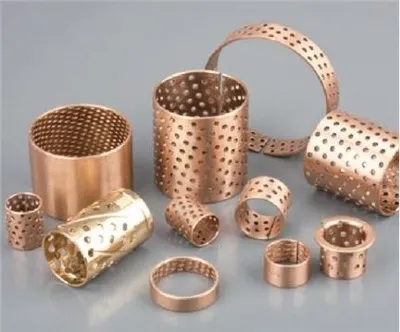
The sliding bearing materials for water pumps are mainly divided into two categories: metallic materials and non-metallic materials.

Metallic materials
The commonly used metal materials for sliding bearings include bearing alloys (also known as Babbitt alloys or white alloys), wear-resistant cast iron, copper based and aluminum based alloys.
1. Bearing alloy
The main alloy components of bearing alloy (also known as Babbitt alloy or white alloy) are tin, lead, antimony, and copper. Antimony and copper are used to improve the strength and hardness of alloys. According to standards, Babbitt alloys can be divided into two types: tin based alloys and lead based alloys. The strength and hardness of lead based alloys are lower than those of tin based alloys, and their corrosion resistance is also poor. So when using Babbitt alloy, tin based alloys are usually chosen, with commonly used grades including ZSnSb11Cu6, ZSnSb8Cu4, etc. Although the performance of lead based alloys is not as good as tin based alloys, they are still chosen for use under the required working conditions due to their cost-effectiveness. Commonly used grades include ZPbSb16Sn16Cu2, etc. However, the melting points of bearing alloy elements are mostly low, so they are suitable for working conditions below 150 ℃.
2. Copper based alloy
Copper based alloys have higher thermal conductivity and better wear resistance compared to steel. And copper based alloys have good workability and lubricity, and their inner walls can be precision machined to make contact with the smooth surface of the shaft. The copper based alloys used as sliding bearing materials mainly include brass with copper and antimony as the main components; Bronze mainly composed of copper and tin; And copper lead alloy (also known as lead bronze). Copper based alloys have high strength, good thermal conductivity and wear resistance, and allow for higher working temperatures than Babbitt alloys. However, their compliance, embeddedness, and friction compatibility are not as good as Babbitt alloys. Commonly used tin bronze containing tin and phosphorus, suitable for bearings subjected to medium speed heavy loads or impact loads; Tin bronze containing tin, zinc, and lead, suitable for bearings with medium speed and medium load.

Non metallic materials
1. Polytetrafluoroethylene
Has good self-lubricating performance and high thermal stability. It has a low friction coefficient, does not absorb water, is non sticky, and non flammable, and can be used under conditions of -180~250 ℃. But there are also disadvantages such as high coefficient of linear expansion, poor dimensional stability, and poor thermal conductivity. To improve its performance, metal particles, fibers, graphite, and inorganic materials can be used to fill and reinforce it.
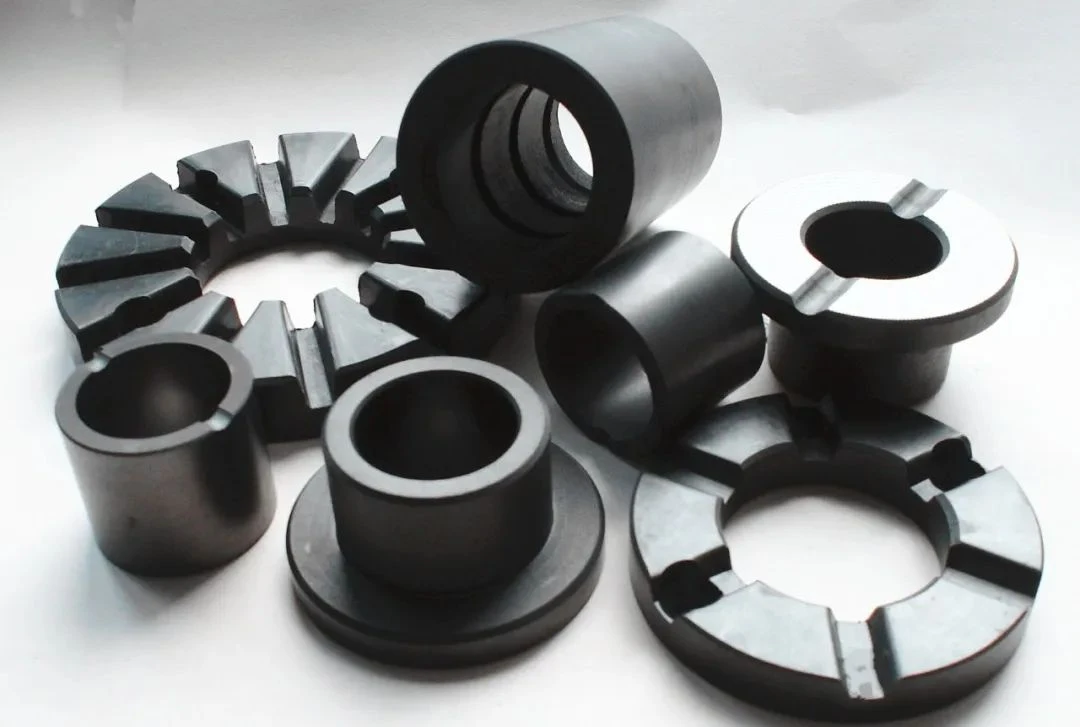
2. Graphite
It is a good self-lubricating material, and because it is easy to process and becomes smoother with grinding, it is the preferred material for bearings. But its mechanical properties are poor, with poor impact resistance and load-bearing capacity, and it is only suitable for light load applications. To improve its mechanical properties, some easily melted metals with good wear resistance are commonly used for impregnation treatment. Common impregnating materials include Babbitt alloy, copper alloy, and antimony alloy. The allowable operating temperature for impregnated Babbitt alloy graphite bearings is 120-180 ℃, for impregnated copper alloy graphite bearings it is 300 ℃, and for impregnated antimony alloy graphite bearings it can reach a working temperature of up to 500 ℃.
3. Rubber
It is a polymer made of elastic material, which has good elasticity and vibration absorption. However, its thermal conductivity is poor, processing is difficult, the allowable operating temperature is below 65 ℃, and it requires continuous lubrication and cooling with circulating water, so it is rarely used.
4. Hard alloy
It has a series of good properties such as high hardness, wear resistance, good strength and toughness, heat resistance, corrosion resistance, etc. Therefore, the sliding bearings processed with it have high precision, smooth operation, high hardness, good strength, and durability, but the price is expensive.
5. Silicon carbide
It is a new type of inorganic non-metallic material synthesized artificially. The hardness is inferior to diamond, and it has good chemical corrosion resistance, wear resistance, high temperature resistance, high mechanical strength, good self-lubricating performance, high temperature creep resistance, low friction coefficient, high thermal conductivity, and low coefficient of thermal expansion. It can be widely used in fields such as petroleum, metallurgy, chemical engineering, machinery, aerospace, and nuclear energy, and is commonly used as a friction pair material for sliding bearings and mechanical seals. A large number of experiments have shown that silicon carbide is currently an excellent material in friction pairs, especially in the performance of pressureless sintered SiC and hot pressed sintered SiC.
2025 March 4th Week Marginal Product Recommendation:
MG-CR Filament Wound Plastic Self-lubricating Bearings:
High strength glass fiber with epoxy resin baked with PTFE and special fiber as bearing lining, the back material provides high load capacity and bearing lining ouers low friction under dry condition. Therefore, this special structure ouered an outstanding anti-wear feature and anti-impact performance, suitable for high load with high corrosion resistance application like lifting machinery, logistic machinery, agricultural machinery, and port machinery etc.
https://www.marginalbearings.com/filament-wound-plastic-self-lubricating-bearings/mg-cr-filament-wound-plastic-self-lubricating.html

If you are interested in our products, please fell free to view here:
https://www.marginalbearing.com/products/catalogue.html
Contact Us:
https://www.marginalbearing.com/AboutUs/contact.html