Experience sharing
The clearance size of tilting pad type sliding bearings directly affects the operating condition of bearings, and there are many cases of bearing damage caused by improper adjustment of bearing clearance. Yue Jingchun, a senior technician at Liaoyang Petrochemical, imparts solutions through experience, which is a rare secret for frontline technicians.
Clearance of tilting pad sliding bearings
Sliding bearings have the advantages of smooth operation, impact load resistance, simple structure, small size, high accuracy, and low vibration, making them widely used in oil refining and chemical machinery. Especially for tilting pad type sliding bearings, the pads can freely swing and move synchronously with the journal, always forming the best oil film when working conditions change. The oil film is stable, has good vibration resistance, is not prone to vortex and oil film oscillation, and can increase the stability of the rotor. Therefore, it is widely used in various major units in chemical plants. However, the clearance size of tilting pad sliding bearings directly affects the operating condition of the bearings, and there are many cases of bearing damage caused by improper adjustment of bearing clearance.
Examples of damage to tilting pad type sliding bearings
In May 2008, the Mechanical Maintenance Department of Liaoyang Petrochemical discovered fatigue damage to the radial bearing pads of the steam turbine during the maintenance of a nitrogen compressor unit at Jilin Fertilizer Plant (as shown in Figure A). After analysis and verification, the cause of the bearing pad damage was fatigue damage caused by excessive adjustment of bearing clearance.
In June 2008, the Mechanical Maintenance Department of Liaoyang Petrochemical inspected a compressor unit in the ethylene workshop of Zhongyuan Ethylene Chemical Plant. During the disassembly of the booster, it was found that the radial bearing pads of the high-speed shaft were severely burned (as shown in Figure B). After analysis and verification, the cause of the bearing pad damage was high temperature burning caused by the adjustment of the bearing clearance being too small.
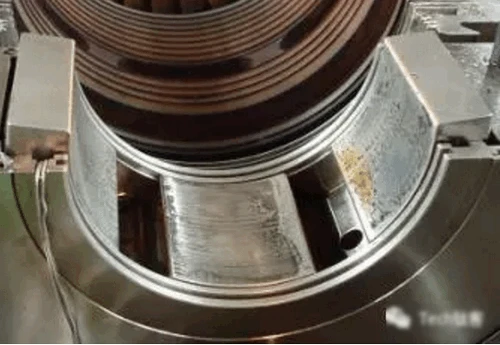
Figure A Fatigue Damage of Steam Turbine Radial Bearing Bush

Figure B The radial bearing bush of the high-speed shaft of the booster is burnt out
From the above, it can be seen that the clearance measurement and adjustment of radial tilting pad sliding bearings are of utmost importance in the installation and maintenance of rotating equipment.
Comparison of several methods for measuring the clearance of radial tilting pad type sliding bearings
1. Lead pressing method
The operation method is to directly remove the upper half of the radial sliding bearing from the body, evenly place the lead wire on the upper half of the journal, and then reinstall the upper half of the sliding bearing. Use the bearing pad and journal to flatten the lead wire, and then measure the thickness of the lead wire being squeezed to obtain the bearing clearance value. Its advantage is that it is easy to operate and can measure bearing clearance without removing the entire bearing from the body. Its disadvantage is that when measuring tilting pad sliding bearings, the measurement values are uneven and the error is large, as the pads can freely swing, making it impossible to measure the coaxiality of a single pad in the bearing body.
2. Axis lifting method
The operation method is to gently lift the rotor journal with a shaft lifter or manual hoist without disassembling the bearing until it fully fits the upper bearing pad (never directly operate with a crane), then lower the journal and fully fit the lower bearing pad, and measure the distance difference between these two positions using a dial gauge, which is the bearing clearance. Its advantage is that the operation is simple, and the bearing clearance can be measured directly in the body without disassembling the bearing. Its disadvantage is that the entire rotor needs to be lifted, and the operation method is cumbersome, which can easily cause damage to the equipment itself; If the internal structure of the bearing is complex and the measurement data is inaccurate, it is not possible to measure the coaxiality of a single tile in the bearing body.
3. False axis method
The operation method is to first create a dummy shaft with the same basic dimensions as the rotor journal, remove the entire bearing, install it on the dummy shaft, and use a dial gauge to measure the bearing clearance by pushing and pulling. Its advantage is accurate measurement and the ability to simultaneously measure the coaxiality of a single tile relative to the entire bearing body. Its disadvantage is that the measurement is slightly complex and requires a certain amount of computational power.
4. Shaft gauge method
The operation method is to first make a dummy shaft with a diameter interval of 0.02mm, and then use the principle of a go no go gauge to sequentially pass the dummy shaft through the bearing. On which dummy shaft does the bearing feel neither loose nor able to rotate, the inner diameter of the bearing can be measured as the size of the dummy shaft.
Based on basic dimensions Φ Taking an 80mm bearing as an example, if the minimum and maximum clearances of the bearing are 0.12mm and 0.16mm respectively, the design size of the inner diameter of the bearing should be Φ 80.12mm to Φ Between 80.16mm, first we need to produce three dummy shafts with a diameter spacing of 0.02mm, namely Φ 80.12mm Φ 80.14mm Φ One 80.16mm dummy shaft each, and then insert the dummy shaft into the bearing in sequence. If Φ The 80.12mm dummy shaft cannot pass through the bearing, indicating that the diameter of this bearing is less than Φ 80.12mm, bearing clearance too small; If Φ If the 80.16mm dummy shaft can easily pass through and there is still clearance, then the bearing diameter is greater than Φ 80.16mm, the bearing clearance is too large, and it is also unqualified; If Φ After inserting an 80.14mm dummy shaft into the bearing, if the bearing is neither loose nor able to rotate on the dummy shaft, the bearing clearance meets the standard.
In order to save materials, multiple fake axes can also be sequentially made on one axis to form a stepped axis, which is shaped much like the combat weapon of the Cold Weapon Age - the whip, called the whip axis. The advantages of this method are simple operation, accurate measurement, and the ability to measure the coaxiality of a single pad in the entire bearing in conjunction with a dial gauge. Its disadvantage is that making a fake shaft or whip shaft requires a certain amount of cost. From the above comparison, it can be seen that the false axis method is an economical and accurate measurement method.
The above is a summary of experience in repairing tilting pad type sliding bearings over the past decade, written here to discuss with everyone. I personally believe that measuring the clearance of tilting pad type sliding bearings is an important task for the maintenance and installation of rotating equipment. Each of the above methods has its own strengths, mainly because the staff should choose suitable operating methods according to local conditions and accurately measure them to ensure the quality of equipment installation and maintenance.
More about Marginal Three-layer metal-polymer self-lubricating bearings:
Three-layer metal-polymer self-lubricating bearing is lighter and has better mechanical and load performance. In addition, the wear resistance and noise absorbing feature is improved while more variable torque range could be fitted.