Abstract: This article focuses on the assembly process and repair requirements of the bearing pads of our 25MW and 50MW units, and discusses the construction methods, requirements, and quality control points during the construction process.
Keywords: bearing shells; Assembly; requirement; Scraping; essentials
Introduction: Split type radial sliding bearings are mainly used on heavy-duty large and medium-sized machines, such as metallurgical mining machinery, large generators, steel ball mills, piston compressors, and transportation vehicles. Its material is mainly babbitt alloy, and in a few cases, copper based bearing alloy is used. During assembly, scraping is generally used to meet its accuracy requirements and ensure its performance. The standards are implemented according to the manufacturer's regulations and personal experience.
Project Overview: Our first phase project units # 1, # 2, # 3, and # 4 are N25-35-1 medium pressure condensing steam turbines produced by Wuhan Turbine Generator Factory. The basic bearing pads are Wu Tao, which are oval shaped and made of Babbitt alloy. The clearance requirements and assembly methods for bearing pads at different sizes of journals are detailed as follows:
1. Requirements for bearing shells, bearing seats, and bearing covers
(1) Load bearing shells. The contact area between the back of the bearing pad and the bearing seat should be greater than 70%, and the distribution should be uniform. The contact range angle a of the bearing should be greater than 150 °, and the clearance B of the remaining parts with clearance should not be greater than 0.05mm. As shown in Figure 1.
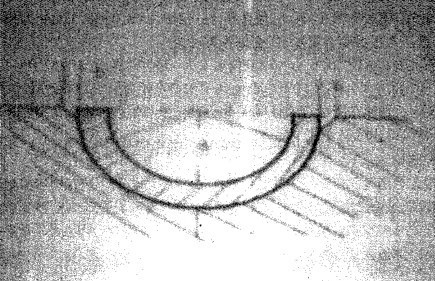
Figure 1
The contact area between the bearing pad and the cover should be greater than 60%, and the distribution should be uniform. The contact range angle a should be greater than 120°, and the allowable gap amount b for parts with gaps should not be greater than 0.05mm.
If the above requirements are not met, the tile base and tile cover should be used as the benchmark, and the contact condition should be checked with coloring method and red lead powder coated. The back of the tile should be trimmed with a fine file until the requirements are met. 3-4 points per 25mm2 of contact spots are sufficient.
When assembling the bearing pad, pad seat, and pad cover, the gasket at the joint of the two halves of the pad should have the same shape as the pad mouth surface, and its width should be less than 1mm measured inside the bearing. The gasket should be flat and free of burrs, and the thickness of the gaskets at both ends of the pad mouth should be consistent. The connecting bolts of the tile seat and tile cover should be tightened and evenly stressed. All components should be cleaned thoroughly.
Several key factors required for the performance of the scraped surface of the bearing pads
(1) Contact range angle and contact surface requirements.
The contact angle of the bearing pad is generally 120°, and for heavy-duty equipment, it is generally 90°. In practical situations, the contact range angle a is also required to be 60°. The size of the contact range angle a and the requirements for contact spots are usually specified in the drawings. If there is no indication, the requirements of the business technical documents can be implemented according to the General technology standards.
(2) Oil line and tile mouth oil groove belt
A. Half start sliding bearings use strong lubrication, and the oil groove is generally open on the non stressed upper bearing (with less force on the upper bearing). The cross-section is a semicircular arc, distributed 180 ° along the inner circumference of the upper bearing, and is machined. The middle position of the oil groove is the same as the oil hole in the center position of the upper bearing, and the two ends are connected to the oil groove belt at the bearing mouth. Due to the existence of a gap in the upper bearing, lubricating oil can easily enter the upper bearing surface and shaft. Its main function is to smooth the lubricating oil, such as the oil groove belt at the inner (radial) side of the bearing shell.
The oil groove belt is distributed at the joint of the upper and lower bearing shells (on both sides). As shown in Figure 1. The oil groove belt is formed into an arc wedge shape, which is a strip oil groove that can store a large amount of lubricating oil, facilitating the lubrication and cooling of bearing shells and shafts. The oil groove belt is usually machined or manually processed by fitters.
Lubricating oil wedge; The lubricating oil wedge is located at the connection between the oil groove belt and the bearing pad within the contact range angle a value, and is manually scraped (commonly known as the scraping port). Its main functions are to store oil to cool the bearing pad and shaft, and to use its arc wedge angle to continuously suck the lubricating oil from the axial width of the shaft to the bearing part under the drive of shaft rotation, so that the bearing pad and shaft have sufficient and good lubrication. The lubricating oil wedge part is a circular arc wedge angle composed of irregular arcs at both ends, which smoothly connects the oil groove belt and the working contact surface of the bearing pad. The connecting part with the oil groove belt should be scraped more, and the edges and corners at the connection of the oil groove belt should be processed and scraped off. At the transition point from the middle of the lubricating wedge angle to the contact surface, the lubricating wedge angle should be scraped into a circular arc wedge angle shape. It should be done when the fine scraping of the bearing pad is basically completed, and it is not easy to scrape in advance.
(4) Top clearance and side clearance of bearing shells
a. The top clearance of the bearing pad can be taken as 1.5% -2% of the shaft diameter based on experience, and should be selected within this range according to speed, load, and lubricating oil viscosity.
b. When there are no regulations on the drawing for side maintenance, the side gap is 1/2 of the top gap. The side gap needs to be scraped out as needed. The side gap should not be opened too large, as this will cause a large amount of lubricating oil to flow away from the side gap and reduce the amount of lubricating oil required for the bearing shells. This should be particularly noted. The widest point b is the planned surface of the tile opening, and the size is the maximum value of the specified side gap. The sharp corner between the side gap and the flat surface of the bearing shell should be chamfered, depending on the size of the bearing shell, generally 1 × 45°~3 × 45°。 The side gap is basically composed of irregular arcs at both ends.
Scraping process of bearing shells
(1) Roughly scrape the bearing shells
a. Lightly scrape the machining tool marks on the upper and lower tiles once, requiring that all tile surfaces be scraped evenly and the machining marks be removed.
b. Apply color to the shaft and rough scrape the upper and lower tiles several times. Then, insert the upper and lower tiles into the tile seat and tile cover respectively. Apply color to the tiles and rough scrape with the shaft grinding points. After the contact area and grinding points are evenly distributed, fine scraping can be carried out.
When rough scraping, attention should be paid to not scraping the part of the tile mouth, and it is required to have full contact within a 180° range.
Carefully scrape the bearing shells. When fine scraping the bearing pads, the upper and lower pads should be padded (at the joint surface of the pad mouth). After assembly, the bearing pads at both ends should be scraped, colored on the pads, and polished with the shaft. When starting the compression assembly, the compression force should be uniform, and the shaft should not be pressed too tightly. It can rotate and the pad should be removed as soon as it is scraped and pressed tightly. At this point, it should also be noted not to scratch the tile mouth. After multiple scrapings, the distribution of spots on the tile contact surface should be uniform and dense.
Fine scrape the bearing shells. The purpose of precision scraping is to scrape the contact spots and contact area according to the requirements specified in the drawing. The grinding method is the same as rough scraping, with the points from large to small and from deep to shallow. At the end of precision scraping, the lubricating oil wedge (opening of the bearing) and side clearance are scraped out to achieve the performance of the bearing bush. This is very important.
When cutting and scraping the bearing shells, it is necessary to consider the conditions related to the shaft during rough and fine scraping, such as center distance deviation, regardless of the contact condition of the tooth surface, in order to ensure the accurate position of the shaft. The small accumulated errors caused by mechanical processing can be further eliminated through scraping. Large errors cannot be solved by scraping.
More about Marginal Three-layer metal-polymer self-lubricating bearings:
Three-layer metal-polymer self-lubricating bearing is lighter and has better mechanical and load performance. In addition, the wear resistance and noise absorbing feature is improved while more variable torque range could be fitted.