The bushing is a key component in the engine. Due to the high speed and heavy load of the engine, there is a high requirement for the adhesion of the coating.
Aluminum has high chemical activity and is very prone to oxidation on the surface. Even if the surface oxide layer is removed, a new oxide film will form in a short period of time. Therefore, electroplating aluminum alloy bearings is more difficult than copper lead alloy bearings.
Electroplating process flow: degreasing → acid washing → zinc immersion → nickel plating → lead tin electroplating
Electroplating aluminum alloy bushing is prone to defects in coating adhesion. The author will discuss typical faults and solutions of poor coating adhesion encountered in the electroplating of aluminum alloy bushing with peers.
1 Fault example
1.1 Poor pre-treatment
Fault phenomenon:
(1) The surface of the coating has bubbles, and after bonding force testing, the bubbling part of the coating peels off, exposing the aluminum alloy substrate.
(2) The surface of the coating is smooth, but after bonding force testing, the coating partially peels off, exposing the aluminum alloy substrate.
Causes and solutions:
Generally, defects such as poor adhesion of coatings are caused by pre-treatment. When the concentration of alkaline and acid washing solutions is not within the process range, or the temperature of the degreasing solution is lower than the process range, or the hydrogen peroxide concentration in the acid washing solution is insufficient, it can cause poor adhesion of the coating. The solution should be analyzed regularly and added in a timely manner to ensure that the composition of the solution is within the process range.
1.2 Delayed nickel plating after zinc immersion
Fault phenomenon:
After zinc immersion, when the positioning of the assembly line crane is not accurate, the nickel anode presses against the fixture, preventing the workpiece from smoothly positioning and timely nickel plating, resulting in large areas of pitting on the lead tin coating. After the bonding force test, all the coatings peeled off.
Causes and solutions:
(1) Due to the easy oxidation of the surface of aluminum alloy, the nickel layer is not easy to deposit. Therefore, before nickel plating, zinc should be immersed as the bonding layer. After zinc immersion, nickel plating should be carried out within 1 minute. Otherwise, the zinc immersion layer will peel off, causing large areas of pitting on the lead tin layer, which affects the bonding strength of the coating.
(2) The zinc immersion solution is too thick, too thin, or the composition ratio is inappropriate; Or improper process conditions, uneven zinc coating or coarse or too thick crystals; Failure to electroplate in a timely manner after zinc immersion can result in poor nickel plating adhesion.
The zinc immersion solution should be adjusted or replaced in a timely manner, and the operation should be strictly carried out according to the process conditions. After zinc immersion, nickel plating should be carried out within 1 minute.
1.3 Temperature changes
Fault phenomenon:
From December to February of the following year, the coating is prone to poor adhesion defects. From June to September, the surface of the coating begins to fuzz. Through the microscope, small micro bubbles can be seen on the surface of the coating, but after bonding force testing, no peeling phenomenon of the coating was found.
Causes and solutions:
We have observed this phenomenon for two consecutive years. Upon inspection of each process, it was found that when the temperature of the zinc dipping solution is below 15 ℃ in winter, the zinc dipping layer is uneven. When the temperature exceeds 35 ℃ in summer, the zinc dipping layer is easily removed. Therefore, we added a temperature control device in the zinc immersion tank to control the temperature of the zinc immersion solution at 15-25 ℃, solving this problem.
1.4 Poor activation before lead tin alloy plating
Fault phenomenon:
After electroplating, the bonding force test showed that the local coating peeled off, but the nickel layer bonded well with the substrate.
Causes and solutions:
Before plating lead tin alloy, activation treatment must be carried out to ensure good bonding between the nickel layer and the lead tin layer. However, due to the presence of organic substances in the activation solution, the adhesion of the coating decreases, so activated carbon treatment is required.
At the same time, when electroplating lead tin alloy, the workpiece must be charged into the groove, otherwise, poor bonding between the lead tin layer and the nickel layer may also occur.
2 Other faults
2.1 There are air flow marks on the surface of the coating
Fault phenomenon:
After electroplating, there are faint air flow traces from bottom to top on the surface of the coating, and in severe cases, there may be a tactile sensation.
Causes and solutions:
(1) Organic contamination in the plating solution requires continuous filtration with activated carbon for 1-2 shifts.
(2) After the machining process before electroplating, there are burrs, rough surfaces, and cutting edges left on the two planes of the bearing and the mating plane. Therefore, they should be inspected and removed before electroplating.
(3) Poor cleaning requires extending the cleaning time, replacing the cleaning water, or checking whether the air stirring in the cleaning tank is normal.
2.2 Faults caused by the quality of aluminum alloy materials in bushing
Fault phenomenon:
After electroplating, there are scattered horizontal pinholes on the surface of the bushing coating.
Causes and solutions:
Due to the high production volume, we believe it is caused by impurities in the nickel plating solution. Therefore, the nickel plating solution is treated using conventional methods. However, after handling two shifts, there are still transverse pinholes on the surface of the coating. Subsequently, we will take the defective bushing for boring, and after removing the coating, we will then bore out 20 more μ After the aluminum alloy layer of m, small pits were found on the surface of the aluminum alloy. We experimented with electroplating bushing with pits, and there were also obvious pits on the surface of the coating. Finally, we replaced the alloy material and resolved this issue.
2024 May 3rd Week Marginal Product Recommendation:
Plastic Self-lubricating Bearings:
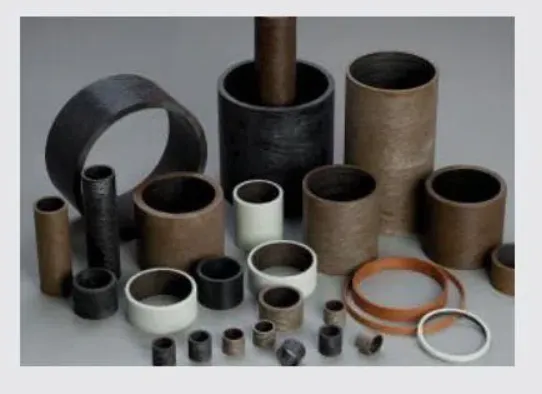
Filament wound self-lubricating bearings,High strength glass fiber with epoxy resin baked with PTFE and special fiber as bearing lining, the back material provides high load capacity and bearing lining offers low friction under dry condition. Therefore, this special structure offered an outstanding anti-wear feature and anti-impact performance, suitable for high load with high corrosion resistance application like lifting machinery, logistic machinery, agricultural machinery, and port machinery etc. This special structure offered an outstanding anti-wear feature and anti-impact performance, suitable for high load with high corrosion resistance application like lifting machinery, logistic machinery, agricultural machinery, and port machinery etc,.