Abstract: The current status of research and development of self-lubricating composite bearing materials in China are summarized. The importance of research and development in this field are discussed. Self-lubricating composite used by Bearing materials in China include cermet and polymer. The future trend is introduced in the end of this paper.
Key words : Self-lubricating ; Materials ; Cermet ; Polymer
Sliding bearings sometimes work under very harsh conditions and are in a dusty environment, which makes ordinary liquid lubricated bearings unable to meet the requirements of special working conditions due to their friction characteristics. The self-lubricating bearing technology completely breaks through the limitation of relying on grease lubrication and realizes oil-free lubrication. The self-lubricating material bearing technology is the current development trend of lubrication technology. The development of self-lubricating composite materials with high mechanical strength and good tribological performance has become an important hotspot in the field of tribology. For example, sliding bearings working under high temperature conditions generally use mineral ceramics and cermets with high hardness, high wear resistance, high mechanical strength and implicit effect on various media; The dry friction bearing used in the structure bearing high pressure shall be coated with fluoroplastic film on the metal base of the bearing pad without cold flow medium. Since the middle of the 20th century, self lubricating bearing materials have been successfully developed and applied in the world, and this field has developed rapidly in China. In this paper, the research and development of metal based and polymer based solid self-lubricating bearings are reviewed.

1 Metal base solid self-lubricating bearing
1.1 Powder metallurgy integrally sintered solid self-lubricating bearing
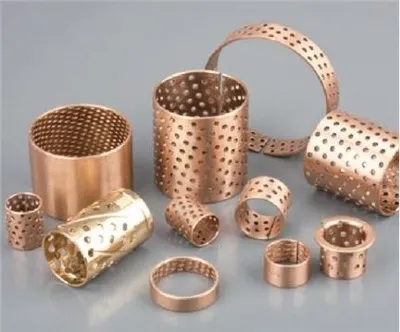
Powder metallurgy self-lubricating bearing, also known as sintered metal oil bearing, is an indispensable type of bearing in audio and video equipment, micro and small motors, office machinery, electric tools, washing machines, electric fans, sewing machines, copying machines, etc. It is to add the solid lubricant in the form of powder as a component to the metal matrix raw materials, and form a self-lubricating composite material by pressing and sintering, which is used as a bearing, bearing pad or lining plate. Because the material itself contains solid lubricant, the bearing will form a relatively stable lubricating film on the relative sliding surface due to thermal action and friction during movement, and will constantly supplement and provide solid lubricant by its own "self consumption" to repair the torn or damaged lubricating film, so as to achieve lubrication and antifriction.
1.1.1 Iron base
Few solid lubricants can withstand high sintering temperature without losing lubricating properties, and their uneven distribution and damage to the continuity of the matrix will significantly reduce the strength, toughness and wear resistance of the composite [3]. The research of Wang Yanjun et al. [4] shows that the effective way to solve the problem of high temperature friction, wear and self lubrication is to take powder sintered cermet as the wear-resistant matrix, adjust the porosity and the shape, size and distribution of the pores by virtue of the particle size, particle shape or forming pressure of the raw powder and the amount of pore forming agent, and impregnate appropriate solid lubricating materials to achieve self lubrication of the friction surface through the role of friction heat in the high temperature friction process. For this reason, they took TiC/Fe2Cr2W2Mo2V mixed powder as the base material, added 3% Ti H2 pore forming agent and Al2O3 as the inert dispersion particle, sintered at 1230 ℃ by vacuum sintering method, and developed a kind of cermet sintering body with uniform pore distribution and interconnected micro pore structure. The test showed that the apparent porosity of the micro porous cermet diffusion self-lubricating sintering body was about 17%, It can meet the requirements of diffusion self-lubricating bearing on pore structure, size and mechanical properties.
Luo Xiyu, General Institute of Iron and Steel Research, Ministry of Metallurgical Industry, et al. [5] invented a kind of material with dense structure, which can be used in metallurgy, machinery, chemical industry and other departments. Large size self-lubricating bearings operating below 500 ℃. Its composition (w) is 5% ~ 30% of any bronze or copper, 2% ~ 5% of cobalt, 2.0% ~ 7.0% of manganese, 1.0% ~ 3.0% of chromium, 3% ~ 6% of eutectic ferrophosphorus (Fe3P or Fe2P), 3% ~ 15% of graphite, 2% ~ 5% of any molybdenum disulfide or tungsten disulfide, and the rest is iron. The material is mainly composed of iron and the matrix phase is pearlite. Manganese, chromium and cobalt are added to improve the thermal strength and wear resistance of the material. Graphite, molybdenum disulfide, bronze and eutectic ferrophosphorus are added to improve the wear resistance and reduce the friction coefficient. In the manufacturing method, the material adopts electric spark sintering or hot pressing sintering.
1.1.2 Copper base
If high-speed (more than 25000 r/min) self-lubricating oil bearing is used to replace high-speed precision rolling bearing in electric tools, the structure of electric tools can be simplified, the volume can be reduced, and the assembly process can be reduced. For this reason, Sun Yong'an developed a bronze based high-speed self-lubricating oil bearing using powder metallurgy technology, using MoS2, graphite, etc. as solid lubricant and phosphorus as solid solution strengthening element. The bearing was tested in the speed range of 25 000 ~ 27 240 r/min. The bench test showed that the load was 10 N, the continuous life was more than 736 h, and the switching times were up to 10 800. The bearing has good heat resistance Superior self-lubricating performance and sufficient wear resistance.
Li Xibin of Central South University of Technology first smelted 82% ~ 88% copper, 5% ~ 7% tin, 5% ~ 7% zinc, 2% ~ 4% lead, mixed evenly, and spray to make copper based alloy powder less than 0.15mm; Then 88% ~ 96% copper base alloy powder, 1% ~ 2% graphite powder, 2% ~ 4% molybdenum disulfide powder as solid lubricant, 2% ~ 5% nickel powder, and 1% ~ 3% tungsten powder as alloy matrix strengthening elements are mixed for 8 ~ 12 h, then the mixture is molded, and the control pressure is 294 ~ 490 MPa; Then sinter the compact with hydrogen at 810-850 ℃ and keep it warm for 1.5-3 hours; Then, the sintered billets are sent into vacuum oil immersion for 4-6 hours; The oiled blank is put into the mold, and the control pressure is 343~784 MPa for fine pressing. After a small amount of subsequent processing, the turbocharger floating bearing can be obtained. The bearing can run at high speed (up to 120 000 r/min), with good self-lubricating performance and long service life. The yield of the invention can reach more than 95%.
1.1.3 Zinc base
Hu Changan [8] invented a manufacturing method of miniature bearing: first, tin 9% ~ 15%, copper 4% ~ 6%, lead 2% ~ 5%, antimony 2% ~ 5%, iron 0.5% ~ 0.8%, nickel 0.5% ~ 0.8%, zinc67% ~ 82% are mixed evenly to make zinc base bearing alloy powder; Then, 80% ~ 95% of the weight of polytetrafluoroethylene is mixed with 5% ~ 20% of the weight of polystyrene to make a solid lubricant; Then take 20%~50% of the weight of solid lubricant and 50%~80% of the weight of zinc base bearing alloy powder to mix to make molding powder; The molding powder is pressed into shape, and the molded parts are put into a nitrogen based protective atmosphere sintering furnace for sintering at a sintering temperature of 360~ 410 ℃ for 30-60 min. The bearing made by the method has the advantages of long service time, good effect, low cost and small space occupation, and can be popularized.
1.1.4 Nickel base
Ouyang Jinlin prepared self-lubricating materials by metallurgical method with nickel as the base material and graphite, silver, antimony, PbO, SiC as the solid lubricant respectively. Its powder metallurgy process adopts vacuum medium frequency induction heating High temperature hot pressing sintering is carried out under the pressure of~1 250 ℃ and 10~25 MPa.
The oil-free self-lubricating bearing invented by Yuan Guodong [10], General Institute of Iron and Steel Research, Ministry of Metallurgical Industry, consists of two components. The first component consists of metal Ni, Co coated lubricant graphite, Mo S2, etc; The second component is composed of carbon and nitride of the IV, V, VI sub group metals and one or more metals of Ni, Co, Mo. The manufacturing method adopts the electric spark sintering process. The material has high strength, good toughness and low friction coefficient.
1.2 Metal base inlaid type
The metal base inlaid type (also known as backing type) is a kind of hole or groove with a certain area ratio that is designed and processed in advance on the metal base (bearing pad), in which a solid lubricating material of certain composition is embedded, and after special bonding and aging treatment, the two are combined into a whole, which is used as the bearing, bearing pad or lining plate. All inlaid holes are arranged crosswise along the direction of motion. There should be a certain degree of tangential overlap between the axial or radial (in terms of the direction of motion) holes to ensure that the bearing lubrication covers the entire sliding direction and forms a complete solid lubricating film. During the movement of the bearing, due to the thermal effect and friction, the solid lubricant is constantly seeping out and transferring, while the matrix is worn and the solid lubricant is gradually exposed, which plays a role in lubrication and antifriction. The bearing embedded with self-lubricating material has high bearing capacity and low friction and wear. It has good self-lubricating property, small friction, long service life and high reliability. It is suitable for use in low speed, heavy load and special environments. It has good load adaptability and is suitable for a variety of motion forms, such as rotation, swing and reciprocating motion.
1.2.1 Bronze base
The main component of the supporting hinge structure of the gate on the hydraulic structure is the self-lubricating spherical plain bearing. The supporting hinge is used to connect with the supporting end of the radial gate arm, transfer the water pressure of the whole gate and part of the gate weight to the gate pier, and ensure that the gate can rotate around the horizontal axis when it is opened and closed. The support hinge is generally about 12 m underwater, and the overhaul is relatively difficult. The water in the gate must be pumped out before it can be carried out. The overhaul period is generally 10 years, and the support hinge should have good wear resistance. The ship lock gate weighs 10~100 t. When the lock is opened, the swing angle is 70 °, and the materials with relative movement are easy to wear. At the same time, in order to ensure the smooth opening and closing of the gate, it is required that the friction between the inner sleeve and the outer sleeve of the support hinge is small. In order to meet the above requirements, Sheng Xuanyu et al. [11] developed inlaid self-lubricating sliding bearings for supporting hinges. The inner ring sleeve of the bearing is made of iron base alloy, and the outer ring sleeve is made of cast aluminum bronze with certain wear resistance and good lubrication performance. The self-lubricating material is embedded on the inner surface of the outer ring. Solid lubricating material in inlay. Before inlaying, it goes through mixing, drying, pressing, sintering and turning. The test also proves that the use of ultra-fine powder material is one of the important reasons for the low friction coefficient of composite solid lubricating materials.
1.2.2 Steel base
Copper base inlaid self-lubricating bearing is more and more widely used in mechanical equipment with inconvenient grease lubrication because of its good friction and wear performance and low cost, and the friction coefficient is about 0.15. However, its maximum bearing capacity is only 90 MPa, which limits its application under heavy load conditions and is difficult to meet the requirements of heavy construction machinery for self-lubricating bearings. Shan Kunlun proposed to develop bearing steel/polytetrafluoroethylene inlaid composite by replacing traditional copper alloy with bearing steel GCr15 based on the quantitative relationship between friction coefficient and load derived from Hertz contact theory and friction adhesion theory. The experimental results show that the bearing pressure of the material can reach 90 MPa, and the friction coefficient is lower than 0.15, which can meet the requirements of construction machinery for heavy-duty self-lubricating bearings. The characteristics of this material are: after spheroidizing annealing, machining, quenching and medium temperature tempering, the structure of steel base GCr15 is fire troostite, hardness 40 ~ 42 HRC; The filler of solid lubricating material is graphite (1% ~ 5%), molybdenum disulfide (1% ~ 5%) and neutral aluminum oxide powder (10% ~ 15%). The matrix is PTFE (residual). After mixing, the solid lubricating material is dried, molded and sintered to obtain the shaped solid lubricating material. The filler is added to the pure PTFE to improve the wear resistance. Adding stone ink and molybdenum disulfide are used to maintain low friction coefficient; Alumina powder is added to improve the wear resistance and achieve the purpose of friction reduction and wear resistance.
Fluoroplastic bearing materials are characterized by small friction coefficient without lubrication, high wear resistance, water resistance, resistance to petroleum products, acids and alkalis. Stable performance in a wide temperature range (from 200 ℃ to 300 ℃). However, the mechanical strength of fluoroplastics is not high. As the most commonly used solid lubricating material, PTFE has low bearing capacity and poor wear resistance. Therefore, the use of pure fluoroplastics will be limited. In the sliding bearing, a thin layer of fluoroplastics can be coated on the working surface of the bearing bush or the metal ceramic and graphite bearing bush can be impregnated with fluoroplastics. The wear rate can be reduced by adding carbon fiber, glass fiber, graphite, molybdenum disulfide and other filler materials. However, the most effective way is to use metal backing. At present, the life of the back lining composite used is not long enough. Wang Chunyan designed the heavy-duty self-lubricating composite by using ANSYS software, and calculated the bearing capacity of the friction pair composed of steel 2 plastic composite embedded with 35 # steel (the lubricant accounts for 55%, 60% and 65% of the contact area) and 45 # steel with PTFE composite. The results show that it is unsafe when the lubrication area accounts for 65% of the contact area. In addition, in their wear experiments, the lubricant formula with the lowest friction coefficient and the best wear resistance confirmed by J Khekar was used: 10%~20% glass fiber (mass%), 2%~5% MoS2 and the remaining PTFE. The lubricant was mixed evenly, dried, and pressed with 35 # steel before sintering.
The friction and wear curves of the self-lubricating composite were measured when the lubricating area accounted for 60% of the contact area. The results showed that the bearing capacity of the self-lubricating composite reached 100 MPa, and the friction coefficient was less than 0.14; Under the conditions of bearing capacity of 80 MPa, swing frequency of 8 times/min and swing angle of ± 30 °, the wear rate is low and the service life is long. The back lining lubricating material that can be used to manufacture self-lubricating bearings is composed of steel back 2 porous bronze 2 polymer lubricating material. Its mechanical properties are equivalent to steel, and its tribological properties are equivalent to polymer materials. It has the characteristics of high strength, small friction coefficient, good wear resistance, excellent thermal conductivity, and wide range of operating temperatures. As the requirements for friction parts such as bearings are getting higher and higher, traditional metal materials can no longer meet the requirements, and the research on new type lubricating materials of backing type has attracted attention. Wang Honggang. The test results of this material show that under high load conditions, the composite is subjected to micro cutting and micro ploughing, and a thick transfer film is produced on the dual surface (45 steel), which reduces the wear rate of the material. This material is suitable for high load conditions with v=0.42 m/s and P=2000 N.
In addition, Xiang Dinghan studied the self-lubricating T-type radial spherical plain bearing developed by Fujian Longxi Bearing Co., Ltd. with American technology: the outer ring matrix is made of bearing steel and hardened, and the inner spherical surface is pasted with PTFE braided composite materials; The inner ring is hardened bearing steel, and the outer spherical sliding surface is plated with hard chromium and polished. The results show that the spherical plain bearing. The load can reach 135 MPa, and the friction coefficient is small and stable. Good self-lubricating performance, low temperature rise after continuous swing, suitable for lubrication and protection of moving machinery under dry friction.
Song Yunfeng established the swing working condition of self-lubricating spherical plain bearing. The simulation test method and test device were used to test the friction and wear performance of GCr15 steel based spherical plain bearing with PTFE/copper mesh composite liner under different load conditions without oil lubrication. The results showed that when the load increased to 40 kN, the friction coefficient and linear wear amount of the bearing increased, and the friction state also changed; 40 kN load has reached or exceeded the pad. Load limit of spherical plain bearing.
In the textile machinery and food machinery industries, oil-free bearings that do not require lubrication need to be used. Li Anguo invented an oil-free lubricating high speed composite bearing material, which is made of carbon steel cylindrical cylinder. The inner wall of the body is sintered with a layer of 0.5mm-1.0mm thick high graphite antifriction material. The bearing made of this material has good wear resistance, high mechanical strength, and the rotating speed can be increased to 3500 r/min with low cost and simple manufacturing process.
1.2.3 Zinc base
A bearing invented by Zhao Changjiang consists of a zinc alloy matrix and a solid lubricating material. It is a new type of self-lubricating bearing made of cast zinc alloy as the base, inlaid with a proper amount of solid lubricating materials on the surface of which the relative friction movement is made, and processed by melting and casting. The zinc alloy self-lubricating bearing has low material cost and simple production process. Due to the good casting performance of zinc alloy, it is easy to process bearing parts with different structures and shapes, and is widely used in various construction machinery.
1.2.4 Others
Carbon fiber reinforced composite is an excellent self-lubricating friction pair material. Due to low wear, small friction coefficient, high thermal conductivity, dimensional stability and corrosion resistance, carbon fiber composites can work with the shaft self-lubricating without oil injection. Bearings made of carbon fiber composites can be used in corrosive media with low lubricating capacity, such as sliding bearings used in gaseous and liquid media. The high-temperature self-lubricating bearing invented by Wang Shunzhen, et al. of Jiutai Bearing Factory [21] is a fixed groove on the inner wall of the matrix. The inner wall of the matrix is attached with a carbon fiber composite layer, and the carbon fiber composite of the carbon fiber composite layer is filled with the fixed groove. The invention has the advantages of small friction coefficient, low wear, no noise, strong self-lubricating performance, wear resistance, etc., and no wear to the shaft, no shaft clamping and holding phenomenon during use, constant operating temperature up to 500 ℃, instantaneous up to 1000 ℃, and stable operation.
American Delaware DuPont Company Yaime A. Amperello 2 Zha invented a saturable non-woven material, which contains fluoropolymer flocs and aromatic polyamide flocs, and can be used as the pad substrate of self-lubricating bearings.
1.3 Gradient self-lubricating materials
Generally, homogeneous self-lubricating sliding bearings are made of porous metal matrix produced by powder metallurgy, and then impregnated with lubricating oil or solid lubricant. The pores are uniformly distributed in the matrix. The greater the strength of the matrix, the better the load. For porous materials, the higher the porosity, the lower the strength of the matrix. In order to improve the antifriction effect and store more lubricants, the porosity of the matrix should be as high as possible. The key to solve this problem is to solve the contradiction between the antifriction effect and the bearing capacity reflected in the use of sliding bearings. For this reason, Jin Zhuoren and Xia Yonghong designed gradient self-lubricating bearings. By adding PbCO3 powder to the matrix, the gradient distribution of the proportion of PbCO3/Fe alloy powder is formed. During the sintering process, PbCO3 is decomposed by heat to produce CO2 gas, leaving pores. The porosity varies with the content of PbC03. The bearing bearing surface is 100% metal, with the minimum porosity and the maximum strength 100% PbCO3 has the largest porosity, which can store more lubricants to maintain the self-lubricating state of the bearing. At the same time, PbO generated from the decomposition of PbCO3 is also an excellent solid lubricant. Compared with general homogeneous oil-bearing, the limit pv value of gradient self-lubricating bearing is increased to 4.0 MPa · m/s, and its service life is more than twice as long.
2 Polymer based
2.1 Fluoroplastic based self-lubricating composite sliding bearing
Li Xuemin et al. [25, 26] of Jinan University disclosed a self-lubricating composite sliding bearing with fluoroplastics as the matrix resin, which is resistant to high temperature. The functional modifier in the material includes a particulate functional filler accounting for 10% to 25% (mass%) of the matrix material and a polymer modifier accounting for 0 to 10% (mass%) of the matrix material. The particulate functional filler includes one or more nanoparticles with a particle size<100 nm. The invention provides a corrosion resistant, self-lubricating fluoroplastic matrix composite sliding bearing with low friction coefficient, good wear resistance, long service life and high pV value.
2.2 Nylon
2.2.1 Nylon self-lubricating bearing material
For sliding bearings working under non lubrication conditions, composite materials based on polyamide and other plastics with different production processes can be used for processing to ensure good dimensional stability and high bearing capacity of friction couples.
Huang Genbao invented a nylon self-lubricating bearing material for machine manufacturing. It is made by adding 50%~160% high-purity graphite and a proper amount of molybdenum disulfide, tungsten disulfide and carbon fiber into nylon substrate, and then through mixing, rolling, molding, oil immersion, softening and other processes. The bearing material has self-lubricating property, good thermal conductivity, heat resistance, wear resistance and high compressive and impact strength.
The invention of Lu Xinxuan of Xi'an Yanta Nylon Products Factory The filled nylon 6-based self-lubricating bearing material is composed of caprolactam (87%), solid lubricating material (10%), and filling material (3%). It has small friction coefficient, wear resistance, good oil storage, strong self lubrication, low cost, and easy installation. It can be used for various machines with heavy load, low speed, medium load, and medium speed, and operating temperature below 110 ℃.
Hua Hongliang used caprolactam as the basic raw material, added solid lubricant, and centrifugal casting method to prepare self-lubricating cast nylon. Glass fiber powder as a reinforcement material is added to the material, so the material not only has self-lubricating property, but also has significantly improved compressive strength, impact strength, heat resistance, wear resistance and antifriction performance, as well as dimensional stability compared with MC nylon based self-lubricating bearing material, thus expanding the application range as a wear resistance and antifriction part. This material can be used for oil-free lubrication of low-speed, medium speed light and heavy load parts under the working temperature lower than 100 ℃. If it works under the condition of oil lubrication, its mechanical efficiency and application range will be further improved and expanded.
Yan Fengyuan of Lanzhou Institute of Chemical Physics, Chinese Academy of Sciences and others invented a self-lubricating nanocomposite. It consists of 100 parts (weight, the same below) of fusible polyimide, 1~25 parts of inorganic nano, and 0.1~2. 0 parts and 5~30 parts of carbon fiber. The material is suitable for vacuum, radiation, high temperature and other special environments, and can be used on self-lubricating bearings and other components in aerospace, mechanical and chemical, automotive and household appliances and other fields. Anshan Jingang Carbon Fiber Composite Co., Ltd. Xu Fuqing.
The invention relates to a high polymer high-temperature non lubricating bearing material used for manufacturing industrial conveying roller table. The polyimide composite is composed of high-temperature resin, solid lubricant and carbon fiber, and there are 6 groups of formulas for synthesizing polyimide. The high temperature resistant and non lubricated bearings manufactured with it can replace all kinds of powder metallurgy oil bearing, metal sliding bearing and rolling bearing. It has the characteristics of energy saving, no environmental pollution and long service life.
2.2. 2 Self lubricating cast oil nylon bearing
Zhang Jingxia invented a self-lubricating cast oil nylon bearing, which is suitable for general sliding bearings. The utility model has the advantages of high mechanical strength, good wear resistance, long service life, low cost, easy installation and simple processing technology.
3 Conclusion
Because the working conditions of bearings, such as temperature, load properties, load types, are very complex, and there are many sizes, how to select and design appropriate materials according to different situations is a complex problem. It is urgent to develop self-lubricating bearing materials under complex working conditions such as high temperature, heavy load, low speed, lining and corrosion. It should be pointed out that the test methods proposed by researchers and developers in this field, such as the novel idea of gradient self-lubricating bearing composites proposed by Chinese researchers, will certainly promote the research and application of composite materials for self-lubricating bearings in China.
More about Marginal Self - Lubricating Bearings:
As a specialized manufacturer of self-lubricating bearings & bushings, Marginal Bearing is devoted to researching and producing new self-lubricating bearing materials.
Self-lubricating bearings, as the name suggests, provide their own lubrication during operation without requiring application of grease or oil lubricants. Due to this, self-lubricating bearings are also referred to as maintenance-free or greaseless bearings as they require no relubrication or grease.

An important distinction to make is that self-lubricating bearings are not bearings that come pre-applied with grease or oil lubricant – these bearings are instead referred to as prelubricated bearings. Prelubricated bearings will require relubrication at some point in their service life.

Self-lubricating bearings work by having lubricant impregnated within the sliding layer of the bearing. This lubricant can either be liquid (oil) or solid (graphite, MoS2, lead) based on the requirements of the application (such as operating temperature). As the bearing operates, the lubricant is released through pores in the sliding layer, lubricating the bearing surface. The lubricant is uniformly dispersed throughout the sliding layer and thus there is no reduction in low friction bearing performance, even if the sliding layer becomes worn. A “running-in” surface is also usually included at the top of the sliding layer to provide low friction bearing performance at start up before the impregnated lubricant reaches the bearing surface.